
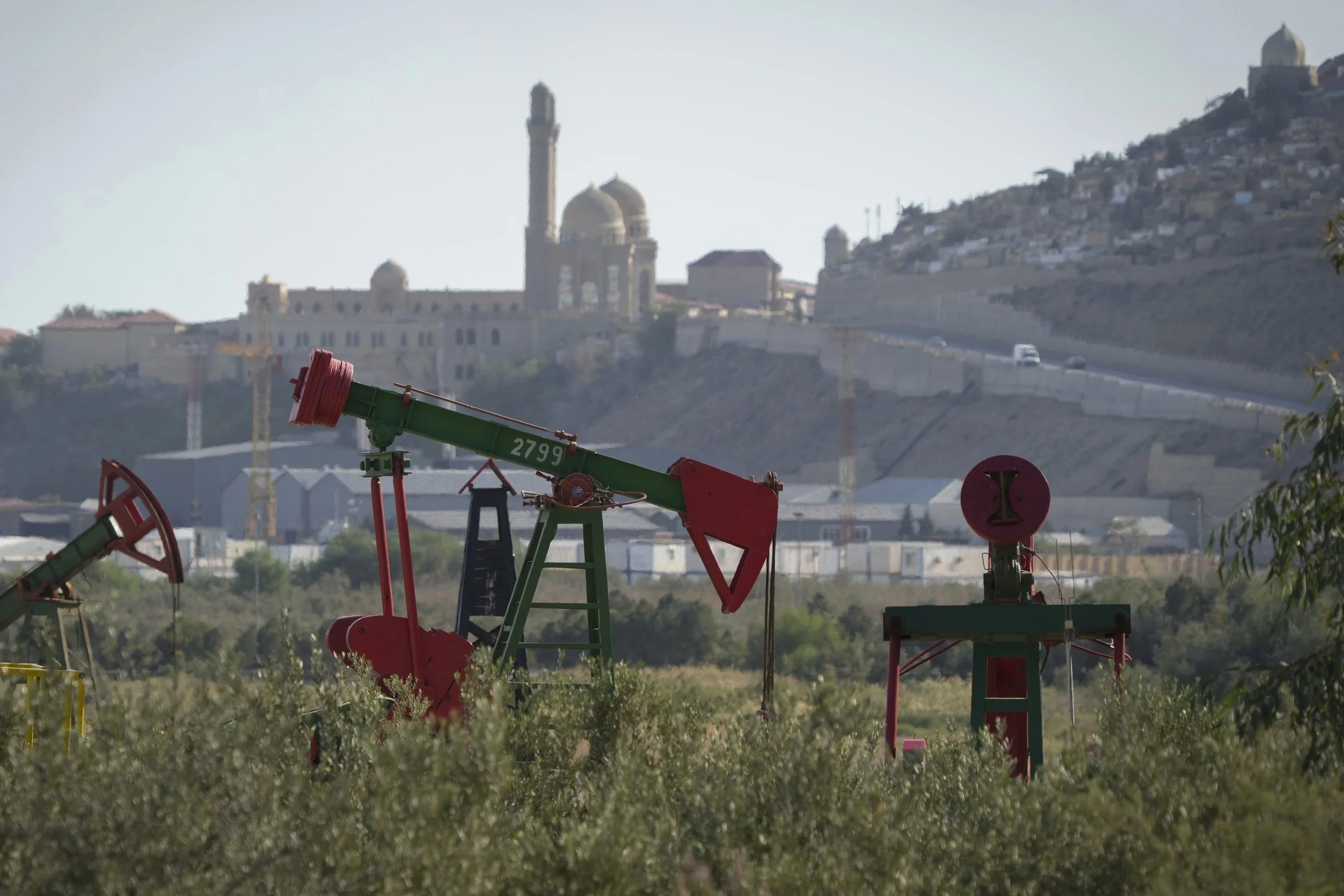
The $600mn Turkic Investment Fund, which was launched in 2024, provides an example of how Central Asia’s asset owners are seeking to support the region’s ambitions, particularly around energy (Sergei Grits/AP)
For a long time Central Asia flew under the radar of the global investment community. But in recent years its asset owners have been touting a clear message for their international peers: the region is ready to do business.
And while the region is still largely dependent on fossil fuels, its geographic and climatic conditions give it a solid potential for the development of large-scale renewable energy projects.
In this context, the $600mn Turkic Investment Fund, which began operating in 2024, is a notable illustration of how the region’s asset owners are seeking to support the region’s ambitions.
“There is a big interest, an increasing interest in Central Asia because of resources in precious metals and renewable energy,” Ramil Babayev, the fund’s general director said recently.
Indeed, a recent note published by the OECD cited Central Asia’s “substantial yet untapped resource base” of critical raw materials, much needed to build infrastructure for the green and digital transitions.
Financed by state capital from Turkic countries, including Azerbaijan, Kazakhstan, Kyrgyzstan, Turkey, and Uzbekistan, the fund is aiming to invest in “bankable projects that deliver measurable development impact and strengthen economic integration among the member states,” Babayev says. And within this strategy, partnership is key.
The fund has also received a $100mn contribution from Hungary, which has held observer status in the Organization of Turkic States since 2018.
Until now, the Turkic Investment Fund has mainly paired with development finance institutions for its investments. But it sees opportunities for partnerships with other allocators as well as investments through asset managers, according to Babayev.
And the fund’s appetite for collaborations is echoed by other asset owners across the region.
In September Israfil Mammadov, chief executive of the $72.6bn State Oil Fund of the Republic of Azerbaijan, said the fund’s aimed to bring “the right public and private partners together” for regional investments, at an event in partnership with BlackRock.
But bringing international investors into the region to develop resource and energy-related partnerships is only one part of the story.
As Central Asian asset owners seek to balance dual mandates - creating diversified asset portfolios, while strengthening the region’s private sector - divesting from state-backed businesses also has a role to play.
One example comes in the form of the National Investment Fund of the Republic of Uzbekistan, established in 2024 with a portfolio of stakes in 13 state-owned enterprises across the energy, utilities, telecoms, transport and financial services sectors.
Last year the fund appointed Templeton Global Investments as its trustee and manager to prepare its portfolio companies for local and global listings and other merger and acquisition transactions.
Similarly the $84bn Kazak sovereign wealth fund, Samruk-Kazyna, has been working to privatise fund-owned assets for around a decade. The fund is in the process of privatising a further 18 assets, as part of its optimisation plan for 2026-2030.
But another fundamental part of Central Asia’s growing attraction relates to its strategic geographic position, sitting at the intersection of Europe, Russia, China, South Asia, and the Middle East. Central Asia asset owners are well-positioned to build cross-border partnerships.
Askar Bilisbekov, chief executive of the Kazakh government-backed investment platform, Alem Capital Management, describes Kazakhstan as “a hotspot” for investment thanks to the country’s high literacy rate and political neutrality.
Since the start of 2026 Kazakstan’s Samruk-Kazyna has signed deals with the Oman Investment Authority and the UAE government as well as committing to $4.3bn of co-investment projects with Chinese companies.
Likewise Sofaz had a flurry of meetings late last year with entities from China, the UAE and Saudi Arabia and in May it co-anchored the Galaxy Orientis China–ASEAN Investment Platform, investing alongside the China Investment Corporation and the Indonesia Investment Authority.
At the time, Sofaz chief executive Mammadov highlighted the fund’s strategy “to build deep, sovereign-to-sovereign partnerships that access the world’s most dynamic economic corridors”.
Indeed the Turkic Investment Fund has signed deals for infrastructure and logistics co-investments with the European Bank for Reconstruction and Development and the Islamic Development Bank.
Meanwhile as geopolitical shifts are reshaping global trade routes, another project is drawing the attention of regional investors: the ‘Middle Corridor’.
Also called the Trans-Caspian International Transport Route, this trade route runs through Kazakhstan, across the Caspian Sea, through Azerbaijan and Georgia, connecting Southeast Asia and China to Turkey and Europe.
Discussions around the development of the route have been ongoing since the beginning of the Russia-Ukraine war and, more recently, disruptions to the Gulf caused by the Iran war have further sharpened focus on the Middle Corridor.
“Because of the tension, [the Middle Corridor] has become the key safest route…That is the big picture right now…there is a big need for an alternate logistics pathway,” Babayev says.
For the Turkic Investment Fund, rallying investors around the project is a central concern, he notes.
Just last month the World Bank released a report on how investment in the region can “transform the corridor into a more competitive, resilient, and growth-enhancing trade route”.