
How much influence do consultants have over exposure to ‘risky’ assets?

Academics at Stanford and Harvard schools of business have found that the rising exposure to ‘risky’ assets in pension funds is closely linked to consultants’ increasing bullishness towards these assets (Yuki Iwamura/AP Photo)
Good morning. Why have so many asset owners increased their exposure to private equity in recent years?
Is it because they have all spotted an opportunity and acted, or is there something more interesting going on?
A group of academics at Stanford Graduate School of Business and Harvard Business School tried to answer this question in a paper called The Rise of Alternatives and they found there is definitely something more interesting going on.
The first thing they have established is that the biggest public retirement plans in the US have been plowing money into alternative assets like private equity, real estate and hedge funds.
Between 2001 and 2021, allocations to alternative assets went from 14 per cent of pensions’ ‘risky’ investments to 39 per cent (this is what the academics refer to as the ‘alternative-to-risky’ share). This phenomenon has taken place in a variety of sectors and geographies.
So why is this happening? The reason for this bullishness, the paper contends, is in part due to the role of investment consultants (though not the only factor).
Space here is necessarily limited so we don’t have time to explain why the authors dismissed other explanations (but they did).
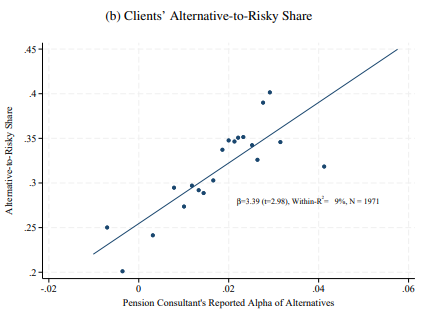
Exposure to risky investments rises in correlation to consultants’ bullishness towards these assets
But one of the pertinent points is that since the early 2000s the average consultant-reported belief in the alpha (or outperformance) available from alternatives increased by 58 basis points.
This rise, the authors say, can be almost entirely attributed to an increase in the expected return of alternatives.
There is also a direct correlation between a pension fund having a higher alternative-to-risky share and their consultant holding a more optimistic view about the alpha on offer from alternatives.
This leaves open one possibility, which is that pension funds are themselves very bullish on alternatives and are picking consultants who share their views.
Juliane Begenau, associate professor of finance at Stanford Graduate School of Business, who wrote the report along with Pauline Liang and Emil Siriwardane of Harvard Business School, suggested the trend was driven by both pension demand and consultant opinion.
She said: “We characterise the portfolio shift toward alternatives as a result of pension beliefs, which themselves are shaped by consultant beliefs, pensions’ investment experience and other pensions’ behaviour.
“Our research shows that consultant beliefs can move pension allocations independently of pension beliefs, i.e. we can control for the effect of pensions choosing consultants in accordance with their beliefs and still find strong effects on allocations. ”
The other point she raised was that the asset class itself has become much more available - but the research showed that while the availability of alternatives has gone up, the share they make up in pension portfolios has gone up by a lot more - meaning these funds are essentially “overweight”.
Have pension funds at least benefitted from this in their returns? Unfortunately it doesn’t look like they have.
Begenau said: “We have tried to look into whether we see benefits at the portfolio level and we didn’t find much.
“The reported volatility tends to be lower because these are smoothed returns but we did not see the ex-post performance differ that much.
“We found no obvious benefits, or costs, that we could see.”
